-
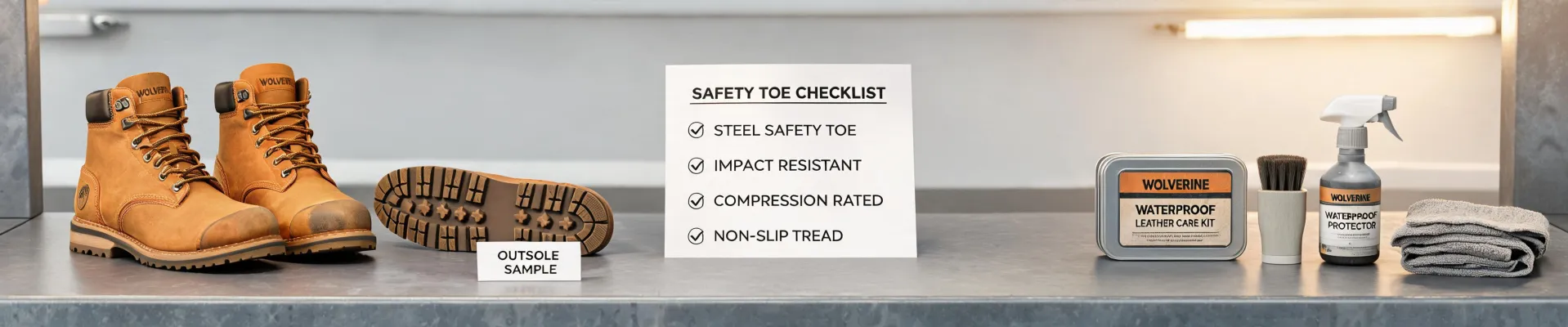
1. Are men's Wolverine steel toe work boots worth the price?
-
2. Safety toe vs steel toe—what's the actual difference?
-
3. How do I choose the right work boots for my job?
-
4. Are Bolle safety glasses actually better than generic alternatives?
-
5. Where do I refill a fire extinguisher, and what does it cost?
-
6. What's the most overlooked piece of PPE?
Seven years ago, I started managing PPE orders for our crew with zero experience and one dangerous assumption: that buying safety gear is straightforward. Eleven documented mistakes later—roughly $4,300 in wasted budget—I can tell you it's not. Here's what I wish someone had answered back in 2017.
In this article:
- Are men's Wolverine steel toe work boots worth the price?
- Safety toe vs steel toe—what's the actual difference?
- How do you pick the right work boots for your job?
- Are Bolle safety glasses better than generic alternatives?
- Where do you actually get a fire extinguisher refilled?
- What's the most overlooked piece of PPE?
1. Are men's Wolverine steel toe work boots worth the price?
Yes. But probably not for the reason you think.
When I first started buying boots, I assumed “expensive equals safer.” That's the classic mistake. Steel toe boots all meet the ASTM F2413-18 standard—it's pass/fail. A cheaper boot passes the same impact and compression test as a premium one. The real difference is in comfort, durability, and how your feet feel after a 10-hour shift.
Our crew gets 14–18 months out of Wolverine steel toe boots in heavy industrial use. The budget pilot we tried in 2017 averaged six weeks before sole separation. Wolverine boots cost us $120–$160 per pair through our distributor (2024 bulk pricing; verify current rates). That's roughly six times the lifespan for maybe one and a half times the upfront cost. Do the math.
There's a hidden cost to early failure too: workers wear worn boots anyway because they don't want the paperwork. A near-miss in 2021—a steel plate dropped on a toe, sole thin enough that the impact transferred straight through—is why I now refuse to stretch a boot's lifespan.
2. Safety toe vs steel toe—what's the actual difference?
This honestly confused me until 2019. I ordered “safety toe” Wolverine boots expecting steel. Different thing.
Steel toe: Meets ASTM F2413-18 impact and compression standards. Heavier. Conducts cold in winter. But it shrugs off impacts that would deform cheaper materials.
Composite or alloy toe: Also meets ASTM standards. Lighter, doesn't conduct temperature the same way. Wolverine groups these under the broader “safety toe” category. The tradeoff is price—typically $20–$40 more per pair.
The oversimplification is that “safety toe” means steel. Actually, safety toe is the umbrella term for any toe that passes the standard; steel is one option, not the entire category. That simple mix-up cost us a $340 reorder in 2022 when I bought composite-toe boots for a crew doing heavy foundry work.
My current rule: heavy falling objects? Steel. Workers complaining about weight and cold? Composite is worth the upsell. Both meet the standard. Match the boot to the actual hazard.
3. How do I choose the right work boots for my job?
Don't start with the brand. Start with the hazard assessment. Three questions I ask for every role:
- What's the actual hazard? Falling objects, electrical work, chemical exposure—each points to specific features. Our electricians need EH-rated boots. Welders need metatarsal guards. The warehouse crew just needs reliable slip resistance.
- How many hours are you on your feet? Our field teams average around 11,000 steps a day. Switching our crew to Wolverine's DuraShock line in 2023 noticeably reduced end-of-day fatigue complaints in our quarterly surveys.
- Do you really need waterproof? Everyone says yes until they sweat through July. Waterproof boots breathe less. Our Arizona crew skips the waterproofing. Our Washington crew treats it as non-negotiable.
The other lesson—well, two lessons. Buy from a distributor that accepts returns. And don't order a half-size up “for toe room.” That mistake caused blisters bad enough to sideline one of our guys for three days. The fix is buying the correct width, not the wrong length.
4. Are Bolle safety glasses actually better than generic alternatives?
Let me be straight: in 2021, I tried to save money with generic $2.50 safety glasses. We went through about 40 pairs in four months—actually 47, I'm mixing it up with a glove order. Lenses scratched within days. Fogging was constant. Workers just stopped wearing them.
Bolle glasses cost $6–$9 per pair from our distributor (2024 pricing; verify current). They lasted three times longer, and the anti-fog coating held up for roughly six months of daily use. The generics fogged up within a week.
The part nobody tells you: the best safety glasses are the ones workers actually wear. If they dislike the fit, they'll take them off when you're not looking. We switched to Bolle's wraparound style in 2023, and our compliance rate jumped from about 70% to 92% in weekly audits. That extra compliance cost roughly $75 per quarter for a crew of 15. Cheapest safety improvement I've ever made.
Both meet ANSI Z87.1 eye protection standards—that's not the difference. The difference is retention: lens coatings that last, and workers who keep them on.
5. Where do I refill a fire extinguisher, and what does it cost?
The answer: a licensed local fire equipment distributor, not a big-box store or a general repair shop. Search for “fire extinguisher refill near me” and check state licensing before you commit.
What it costs: $20–$35 for a standard 5-lb dry chemical refill, plus inspection fees, based on quotes we collected in 2024. Verify current rates with local distributors. Some charge separately for the inspection tag—annoying, but common.
The mistake that cost $450 and a citation: in September 2022, we sent a partially discharged extinguisher to a general repair shop that offered refills. They topped it up with dry chemical—no hydrostatic test, no proper recharge tag, no certified tech sign-off. The fire marshal caught it during a routine inspection. Failing an inspection over a five-dollar tag is exactly the kind of expensive negligence you want to avoid.
Ask for certification documentation before handing over your extinguishers. Make sure the service follows NFPA 10 standards. If a vendor hesitates to show credentials, walk away. That hesitation is your red flag.
6. What's the most overlooked piece of PPE?
Nobody guesses this one: insoles.
In early 2023, our crew reported back and knee pain during annual reviews. I prepared a whole cost analysis for switching to a more expensive boot line. Then a 25-year veteran foreman suggested trying properly rated insoles first. We spent $450 on industrial insoles for 15 guys. Back complaints dropped by more than half within a month. The boot switch we were considering would have cost at least six times that.
It's tempting to think the obvious PPE line items are the whole story. The reality is that the best safety investment often sits unnoticed inside the boot, carrying the load every single day.
That's it. That's the whole lesson.