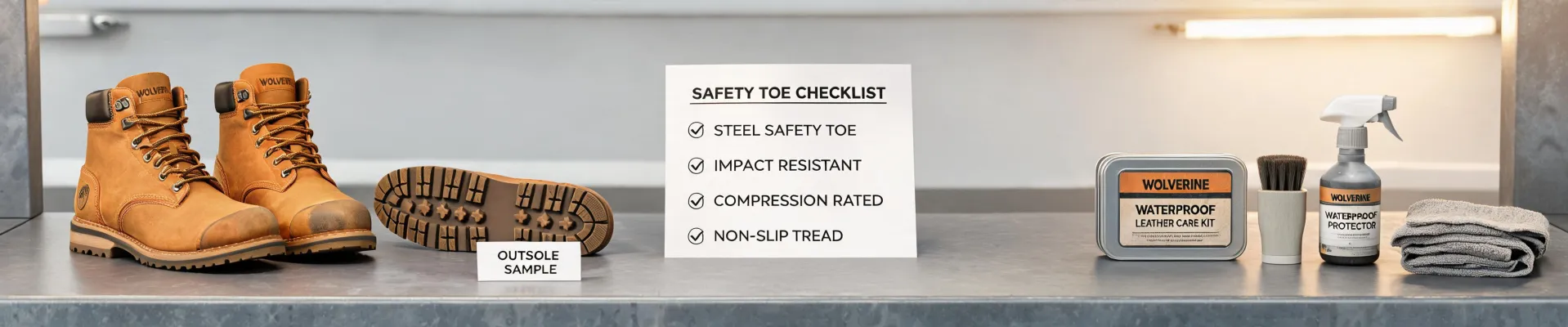
Last March, I found myself in the maintenance bay at 6:45 AM holding a steel toe boot that had split clean along the toe crease. The date stamped inside was eight months old. For a boot rated for daily industrial use, that's... not good. That boot cost me $47. I'd bought twelve of them in Q2 the year before, confident I'd cracked the code on trimming our safety gear spend.
The safety manager walked in, saw the boot, and said four words I've been replaying in my head ever since: "I told you so."
Six Years of Tracking Every Dollar
I should back up. I'm the procurement manager at a mid-sized fabrication company in Ohio—46 people on the floor, 11 in the office, and one extremely territorial office cat named Gerald. For the past six years, I've managed our safety and work gear budget: roughly $180,000 annually across footwear, PPE, fire safety, and first aid. I track every order in a spreadsheet that has become something of a department legend. 2,400 line items, color-coded by category, with a notes column reserved for what I optimistically call "learning opportunities."
In 2023, we got hit with a third-party safety audit. Not a catastrophic failure, thank god—no OSHA citations—but enough findings that I couldn't ignore them. Three things in particular stood out:
- PPE training documentation was thin. We had attendance sheets from safety meetings, but no verification that employees actually understood when and how to use their gear.
- Two fire extinguishers were past their service intervals.
- Footwear was inconsistent: guys were wearing athletic shoes and non-rated boots in areas where steel toe protection was mandatory.
The footwear finding hit me hardest, because I was the one approving the purchase orders.
How I Talked Myself Into $47 Boots
Here's where I have to own a mistake. In late 2022, I compared three vendors for steel toe work boots. Our regular brand, Wolverine, quoted $138 per pair. A budget brand came in at $89. The math was tempting: $49 difference per pair, 24 pairs needed, roughly $1,176 in savings. My TCO spreadsheet said go cheaper. There was just one problem: my TCO spreadsheet had no line item for "boots that fall apart in eight months."
I went with the budget vendor. And by month six, the first pair came back with sole separation. By month eight, the split-toe incident. By month ten, we'd replaced nine of the twenty-four pairs. That's $801 in replacements, a ton of admin hours processing warranty claims, and a safety manager who'd earned the moral high ground permanently.
The kicker? When I did a proper side-by-side spec comparison, the cheap boots technically met ASTM F2413-18 for impact and compression. Technically. But the Wolverine boots had full-grain leather uppers, a thicker outsole, and a composite toe option for the electricians who work around live panels. The cheap boots had a price tag. That was their headline feature.
I'm not saying budget boots are never the right call. I'm saying my "savings" turned into a roughly $1,700 problem when I factored in replacements, expedited shipping, and the cost of losing trust with the crew. The next time someone tells me a cheaper boot "meets the standard," I'm going to ask them: for how long?
Three People, Three Versions of "PPE Compliance"
The audit didn't just flag boots, though. One finding stuck in my craw: our training records didn't show that workers understood when and how to use PPE. This one hurt, because it exposed a communication failure I'd been blind to for years.
Our safety manager, our shop steward, and I all used the phrase "PPE compliance." We all meant completely different things.
I meant the budget was approved and the P.O.s were placed. The safety manager meant workers were trained, fitted, and documented. The shop steward meant the right gear was actually on the floor, in the right sizes, at the right time.
We discovered this mess at the audit. The "training records" we'd been signing were attendance sheets. We'd documented who showed up to the safety meeting, not whether anyone learned anything. The auditor put it more politely than I'm about to: "This is a list of people who sat in a room. It doesn't tell me what they know."
The big OSHA question—who is responsible for making sure that workers know how and when to use PPE?—has a clear answer. The employer is. Under 29 CFR 1910.132, you have to train employees and verify they understand. I'd always kind of assumed that was "the safety guy's job." It's not. If I'm approving a purchase order for a hundred pairs of safety glasses but nobody's trained on when to swap them out, I own part of that gap.
The Fire Extinguisher That Sent Me to Google
And then there were the fire extinguishers.
The audit flagged two expired units: one in the welding bay, one near the loading dock. Seemed like a quick fix. Buy new ones. Then I found out the company we'd used for annual inspections had changed their contract terms, and our maintenance schedule had quietly lapsed.
It was a Thursday afternoon when I typed "fire extinguisher recharge near me" into Google, fully expecting to find a local vendor who'd handle it the next day. The nearest certified tech was forty minutes away and booked out two weeks. My options: pay $180 for a recharge plus a $75 trip fee and wait, or buy two new units at $130 each and be compliant immediately.
The spreadsheet said recharge was cheaper. My gut said waiting two weeks was a gamble with a re-inspection deadline hanging over us. I went with the new units. And then came the surprise: when I read the date stamps more carefully, those extinguishers were five years past their hydrostatic test interval per NFPA 10 guidance. The annual service had lapsed at least twice under the previous building owner. Recharge wouldn't even have been legal—those units needed to be retired, full stop.
The $260 for new extinguishers felt painful. The $95 disposal fee felt worse. But knowing we were compliant was worth every penny. I should have checked those date stamps in 2022. I didn't. That's on me.
Fixing It: Boots, Glasses, and a Fresh Start
Heading into 2024, I had three things to fix: footwear consistency, PPE documentation, and a fire safety vendor who answered emails.
Standardizing on Steel Toe Men's Wolverine Work Boots
Footwear was the easiest once I stopped trying to be clever. I asked the crew what they actually wanted. The consensus came back around Wolverine.
We ordered 28 pairs of steel toe men's Wolverine work boots—two versions: lace-up for most of the crew, pull-on for the guys who wanted something faster to get into. The full price tag was $3,864. I know that sounds like a lot next to the $89 boots. But the "cheap" experiment had already cost us $2,196 in failed boots, plus weeks of admin time, plus zero goodwill on the floor. The Wolverines ran the full year with zero failures. Not one pair returned. Not one warranty claim.
I'll be honest: I'm not here to claim Wolverine is the only good boot out there. I can only speak to our shop's data. Fourteen months in, those boots are still going strong. The cost per wear is embarrassingly low, and the foot fatigue complaints dropped off, which is a morale win I can't measure in dollars.
Eye Protection, or the Uvex Difference
For eye protection, we moved to uvex safety glasses—the wrap-around SCT style. We'd been buying the cheapest $2 glasses we could find, and they ended up in the trash by lunch. The uvex ones cost more, around $6 a pair, but they stay on people's faces and handle the occasional scratch without losing visibility. That's a cost-per-wear difference, not a brand loyalty thing. A pair of glasses that gets worn all day beats a pair that gets pocketed at 10 AM.
Rebuilding Training From the Ground Up
The training piece was the real project. We scrapped the attendance-sheet system and built a hands-on verification program. Every employee now has to demonstrate that they can properly put on their PPE, adjust it, identify damage, and explain when to replace it. We document each step, and we keep records by employee, not by meeting date. The rollout took about six weeks and cost a few hundred dollars in materials. At the next audit, the same reviewer looked at the new process and said—I'm not making this up—"this is how you do it."
The Bottom Line
So what did I actually learn from all of this?
First, price is the beginning of a conversation, not the end of it. If your vendor comparison spreadsheet doesn't have a column for "what happens when this fails," you're not doing total cost of ownership. You're gambling.
Second, "PPE compliance" means different things to different people. Sit down with your safety manager and your floor supervisor before the auditor does it for you. Define what training, documentation, and gear availability actually look like in your facility.
Third, the employer owns PPE training. Not the safety guy. Not the foreman. The company. That's 29 CFR 1910.132 in plain language. If your workers don't know when to swap out scratched face shields or cracked boots, that's a program gap, not a personnel problem.
Fourth—and this one's a little uncomfortable—sometimes spending more is the cheaper move. I hate that the market works that way. I spent years believing the lowest quote was the most responsible choice. My own data says otherwise. The Wolverine boots were, on a per-wear basis, significantly cheaper than the budget alternative. The uvex glasses, same story. The new fire extinguishers, painful up front, but they bought us a compliance record we can actually stand on.
If you're in procurement and you're heading down the same path I took, do me a favor. Take this with a grain of salt—every shop is different, and I'm not 100% sure my numbers translate to your industry. But build a failure-rate line item into your vendor comparison. Check the date stamps on your fire extinguishers. And next time someone calls a cheaper boot "the same thing," ask them how long it actually held up.
There's something genuinely satisfying about looking at 2024's budget now: safety gear spending slightly under forecast, zero audit findings, and a row of well-worn Wolverine boots that logged more hours than any pair from the previous cycle. After the stress of 2023, that's the payoff.