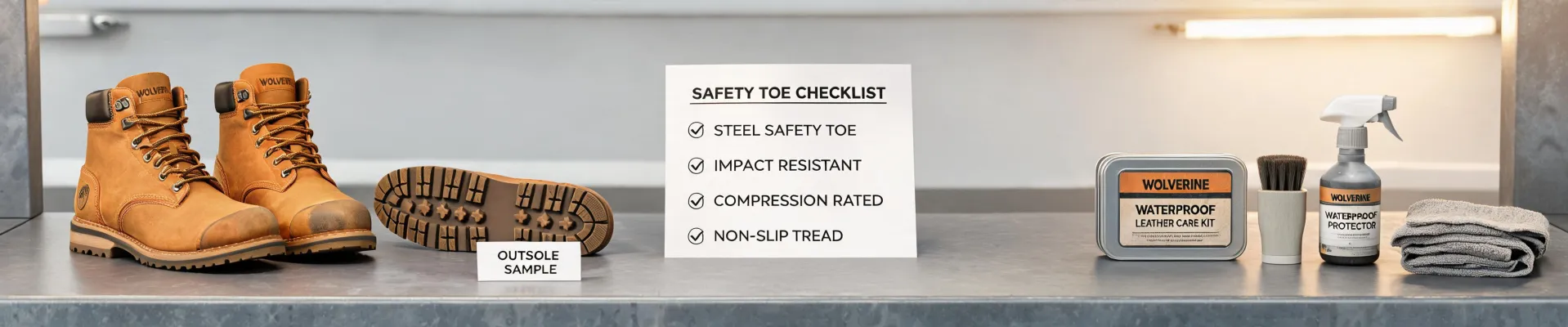
I've managed the safety gear budget at a 240-person industrial company for six years. That's roughly $180,000 a year across 40+ vendor relationships, all documented in a cost tracking system I built after getting burned on hidden fees one too many times.
The question I hear more than any other isn't “which boot is best?” It's “where should I buy work boots?” The honest answer: it depends.
Maybe you're browsing Boot Barn's Wolverine selection, wondering if the Wolverine EPX steel toe boots justify the price tag. Maybe you're weighing Wolverine against Timberland for a crew order. Maybe you just need to round out a PPE kit with leather gloves and photochromic safety glasses. Whatever brought you here, the answer starts with your situation, not with a brand name.
Three Questions That Change the Answer
- Who is this for? Just you, or a team of workers?
- What's your timeline? Do you need boots this week, or can you plan the order?
- What's the real cost of failure? If a pair of boots doesn't hold up, is one person uncomfortable—or does a whole crew lose productive time?
These three answers put you into one of three scenarios. Let's walk through them.
Scenario A: Buying One Pair for Yourself
If it's your own money and your own feet, the goal is simple: maximize comfort and durability per dollar.
My advice? Try before you buy. Online reviews are helpful, but work boot sizing is genuinely inconsistent between models—even within the same brand. The Wolverine EPX steel toe boots, for example, run narrow in the toe box during the first week or two until the leather relaxes. Whether that works for you depends on your foot shape. You can't learn that from a spec sheet.
I know the temptation to order online and save a trip. Here's what happened the one time I gave in. I knew I should drive the twenty minutes to a store and try the boots on, but the reviews were unanimous, the price was right, and I figured: what are the odds the sizing is off? Well. The odds caught up with me. The boots fit fine for the first two hours, then pinched my toes for the next nine. By the time I accepted they weren't going to break in, the return window had closed. $180 down the drain because I skipped a twenty-minute drive.
Where should you go? Boot Barn is a solid option—their Wolverine stock runs deep, and you can try several models side by side. Local workwear shops work too. The key is that you're putting the boots on your feet before committing.
Online is a no-brainer once you know your exact size in a specific model—say, a reorder of boots you've worn for a year. Just check the return policy first. Actually, check it twice.
And don't save $30-$40 by going for the cheapest pair on the wall. I've seen budget options flatten their insoles within two months of daily use. Re-breaking-in a new pair costs you weeks of comfort, and the “savings” disappear fast.
Scenario B: Outfitting a Small Crew (2-20 Workers)
The math changes when you're buying for multiple workers. You're no longer asking “which boot fits me?” You're asking “which boot fits the most people well enough?”
For crews this size, standardize. If you let ten workers each pick their own brand, you end up with ten different models, random sizes in stock, and zero leverage with suppliers. Pick one primary model and one alternative. That's it.
For general industrial and construction environments, the Wolverine EPX steel toe boots have become our default for new crew members. They meet the ASTM F2413-18 standard for steel toe protection, which covers most warehouse and construction work, and the break-in period is short—about 3 to 4 days in our experience. Workers are productive faster, which matters more than five dollars on a price tag.
For sourcing, I've had better results with a retailer's outfitter program than buying direct from a manufacturer. Boot Barn's outfitter team, for example, handled size exchanges through the local store instead of a national returns department. That saved us days of waiting. And asking for a volume discount got us 8% off a 15-pair order. The worst they can say is no.
Timing matters more than people expect. I once ordered crew boots nine days before a project start date, assuming it'd be enough lead time. It wasn't. Three workers pulled their first week in old boots while the new ones were still breaking in. Give yourself 14 days minimum—three weeks if you're ordering a spread of sizes and widths.
While you're placing that order, add the rest of the PPE. Leather gloves for general handling—buy by the dozen and the per-pair price drops substantially. And consider photochromic safety glasses for crews that move between indoors and outdoors. They darken automatically in sunlight and go clear inside, which solved our “left my sunglasses in the truck” problem. Compliance on eye protection went from 74% to 98% after the switch. Just make sure they carry the ANSI Z87.1+ impact rating.
Scenario C: Running an Annual PPE Program (20+ Workers)
If you're buying for a larger workforce on an ongoing basis, you're not making a purchase—you're building a program. And the only number that should drive your decisions is total cost of ownership (TCO).
Here's a concrete example from our records. In early 2024, I compared two options for our 32 welders and fabricators:
- Option A: the lowest-priced steel toe boot we could source, at $95 per pair
- Option B: the Wolverine EPX steel toe boot at $145 per pair
On paper, Option A looked like the smart buy—$50 less per pair, $1,600 saved up front. But here's what happened.
The A boots started failing at month five. Split soles, broken shanks, one steel toe that separated from the upper entirely. By month eight, 30 of the 32 pairs had been replaced at least once. That's $2,850 in replacement boots, $570 in expedited shipping—because failures don't schedule themselves—and four hours of my time processing reorders.
The B boots? 28 of the original 32 were still in active service at month 12. One pair failed and was replaced under the one-year warranty at zero cost. Total reorder time: one email.
The math is hard to argue with. The cheap boots cost us $3,420 in replacements and shipping on top of the initial $3,040. The “expensive” boots ran $4,640 total and stopped costing money after the first month. At the end of the year, the budget option was approximately 25% more expensive—and that's before factoring in the downtime when a worker's only pair of boots becomes unwearable at 9 AM on a Tuesday.
Looking back, I should have built a TCO model in year one of this job instead of year three. At the time, I was focused on the headline number—price per pair—and didn't have enough data to see how replacement costs were eating the budget. Now every major PPE purchase goes into the same spreadsheet.
What about Timberland? I get this question constantly, usually from people searching “where to buy Timberland work boots.” So here's the honest procurement-geek take.
Timberland makes a genuinely good work boot. Their Pro line is well-constructed and comfortable, and if a worker specifically wants Timberland, I don't argue. Get them the boot they'll actually wear. The only reason I don't default to Timberland for fleet purchasing is availability consistency, not quality. Wolverine's work boot line is stocked more predictably through retailers and outfitters, which means faster replacement when somebody needs a new pair. For ongoing procurement, that reliability matters more than any brand loyalty.
For the actual buying: maintain one primary supplier and one backup, and require quotes from at least three vendors on any order above $1,500. We implemented that policy in Q2 2024 after I almost renewed a contract out of habit. My gut said “stick with the vendor you know.” The data said to shop it around. I did, and the identical order came in $2,100 lower at a different supplier. That's 11% we almost left on the table.
A note on pricing, by the way: the numbers above are from early 2024. Boot prices shift by small amounts each year, and leather glove pricing moves almost quarterly. Verify current rates before building your annual budget. The ratios hold up, but the dollars don't stay still.
How to Know Which Scenario You're In
Still not sure? Here's the shortcut:
- One pair, personal purchase → Scenario A. Go to Boot Barn or a comparable store, try on the Wolverine EPX in person, and trust your feet over the reviews. Buy online only for exact reorders of known sizes.
- 2-20 workers, one-time or seasonal → Scenario B. Standardize on one primary model, order at least 14 days ahead, and bundle boots with leather gloves and safety glasses to simplify your vendor list.
- 20+ workers, ongoing → Scenario C. Build the TCO spreadsheet before you write the purchase order. Track replacement rates, expedited shipping, and your own labor hours. Get three quotes minimum for anything above $1,500.
Bottom line: the biggest mistake I see is treating an ongoing procurement program like a series of one-time purchases. If you buy repeatedly without tracking the data, you'll pay the most while thinking you're saving. The right place to buy work boots isn't one answer—it's the answer that fits your scenario.