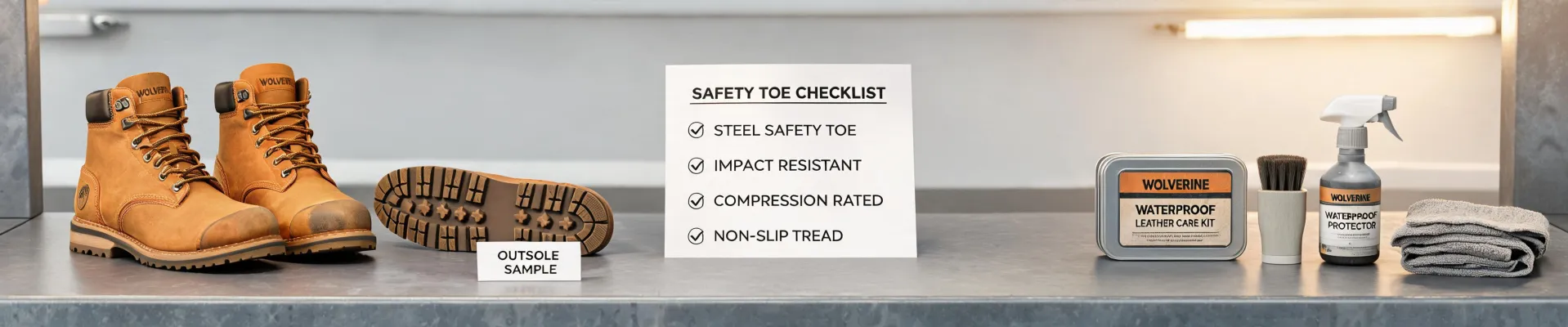
On a cold April morning in 2022, I stood next to my truck with three pairs of brand-new work boots in the back. They had arrived two days earlier from an online listing that looked totally normal. The boxes were clean. The leather was stiff. The soles looked aggressive enough for the muddy yards we work in.
Then I flipped open the tongue of the first boot and didn't see the label I expected. No ASTM mark. No safety-toe rating. Nothing except a size tag.
That was the moment my cheap-boot experiment ended.
I handle boots and PPE for a 14-person fence crew. I've done it for six years (since 2019), and I've personally made enough ordering mistakes to total about $1,850 in wasted budget. This is the story of the worst one.
Why I ended up ordering boots for a fence crew
I run field operations and handle safety gear for a small company that builds residential and light commercial fences. People search "fence companies near me" and choose us based on our workmanship, but nobody asks who makes the boots our crew stands in all day. That part is my job.
When I first started in this role, I let each installer pick their own boots and reimburse up to $75. That didn't work. One guy wore hiking shoes. Another had a pair of steel toe boots with soles so smooth they were dangerous on wet concrete. A third bought a composite-toe model but couldn't tell me if it met any standard. So in early 2020 I took over the boot ordering and built a size-and-model spreadsheet. It worked fine until I tried to be too clever with the budget.
The order that made me rewrite everything
In March 2022, we hired three new installers and I needed three pairs of boots. At that time, our go-to was a Wolverine lace-up steel-toe boot with an ASTM F2413-18 rating. It cost about $110 per pair on Amazon (prices have moved since then, so verify current rates). I had ordered it for two years with almost no complaints.
Then I saw a listing for "safety toe" work boots for $79.99. The reviews were good. The photos looked similar. My budget brain said: four-star rating, budget brand, significantly less money. I ordered three pairs before checking the spec sheet. Saved $90. That was the trap.
Saved $90 on that order. It ended up costing roughly $500 when I counted the replacement boots, the overnight shipping, and half a day of lost crew time.
Here's what I missed: the listing said "safety toe" but never mentioned ASTM. When the boots arrived, I looked at the label inside the tongue and found no impact rating, no compression rating, no standard at all. I called the seller. "Soft toe," they told me. The boots looked like safety boots, but they were basically heavy outdoor shoes.
The most frustrating part: I didn't catch it. A client's site safety auditor did, during a walkthrough. He asked to see the ASTM labels on the new guys' boots, and they couldn't show one. He didn't kick us off the site, but he made it clear the crew couldn't work in those boots until they had compliant protective footwear.
So I returned the budget boots, paid $47 for overnight shipping on three pairs of the Wolverine boots we should have ordered in the first place, and watched the new crew sit in the trailer for half a day. (note to self: never buy a new safety model without reading the spec sheet first.)
The checklist that fixed our boot ordering
After that incident, I made a one-page boot checklist. It looks simple, but it would have caught every one of my mistakes.
- Check the safety standard. The label must show ASTM F2413-18 (or a newer revision). "Safety toe" in a product title doesn't count.
- Choose the toe style by hazard. Steel toe is our default for fence work because we handle metal posts and heavy gates. Composite and alloy toe are lighter options that still meet the same standard. Decide by job site, not by color.
- Pick lace-up or slip-on deliberately. Lace-ups give better ankle support on uneven ground. Slip-ons are easier for guys who are in and out of trucks all day. Both can be ASTM-rated—just confirm it on the model you choose.
- Check soles and waterproofing. Fence work means mud, wet grass, and gravel. A slip-resistant sole matters more than the logo on the side.
- Buy from a source you can return. I usually search "Wolverine work boots Amazon" because the selection and return policy are convenient. But I only order from authorized sellers. A counterfeit ASTM tag is worse than no tag.
- Verify size and width before ordering. We keep a size log, and every new hire has to walk in a pair of sample boots before we order. That rule came after I ordered a 10.5 that fit like an 11.
I also added one line to our PPE order form: if the spec sheet doesn't show an ASTM standard, the model is not approved. In the past 18 months, that line has caught at least 30 potential mismatches before they cost us money.
What we use now, and what I still get asked about
Most of our crew wears Wolverine boots now. Not because they're the only good work boot out there, but because they have been consistent for our mix of foot shapes and job sites. The steel-toe models hold up to fence work, the soles grip wet grass, and the size range covers our wide-foot guys. Waterproof versions are worth the extra cost for anyone who works in damp yards.
Two of our crew leads wear Wolverine slip-on work boots. Slip-ons are not right for everyone—you lose some ankle support compared to lace-ups, and if you're on uneven slopes all day, you may want a boot you can tighten. But for guys who are constantly hopping in and out of trucks, the slip-on style saves time and stays out of the way. The model we buy has a composite toe, is waterproof, and meets the same ASTM F2413-18 requirement. One sizing tip: if you're between sizes, order the larger one because you can't tighten a slip-on.
When I order online, my search often starts with "Wolverine work boots Amazon." The filters help me check width and safety rating. I also double-check the seller's name on the listing. If the price is too good and the storefront looks generic, I move on.
Other brands come up too. We've had crew members consider Caterpillar work boots, and some of those are solid choices. I've also had new hires ask "who sells Brunt work boots near me?" because they've seen the brand online. If that's your preference, use the store locator on their site before ordering. I don't have anything against Brunt—I just don't standardize our whole crew on them because Wolverine's sizing and slip-on options fit our records better.
And to the people searching "fence companies near me": ask what the crew wears. It's a fair question. A reputable fence company should know whether their protective footwear meets the relevant standard. If the owner shrugs, that's a red flag.
I still believe small orders deserve good products
I get the instinct to save money on work boots. Small companies don't have endless budgets. I also get why someone might look at a $79.99 boot and think it's the smart move. But this is one place where the "cheap option" has a hidden price. The real total cost included the return shipping, the rush order, the lost half-day, and the awkward conversation with a safety auditor.
To be fair, the budget boots might have been fine for someone who doesn't need protective toe footwear. Our crews work with metal posts, heavy gates, and uneven terrain. The requirements are different. So now I use the ASTM label as the first filter, not the brand name. If a boot can't prove it meets the standard, it doesn't make the approved list.
When I was starting out, the vendors who treated my small orders seriously are the ones I still use today. Small doesn't mean unimportant—it means potential. Our crew has grown from four people to fourteen, and the equipment chain that supported us at four is still what supports us at fourteen.
According to OSHA's foot protection standard (29 CFR 1910.136, via osha.gov), employers are responsible for making sure employees wear protective footwear when hazards exist. The standard points to performance requirements like ASTM F2413. That's the floor—not a suggestion.
There's something satisfying about opening a shipment and seeing the ASTM label right where it should be. After the 2022 disaster, that small check gives me more confidence than any marketing claim. I'd rather pay an extra $30 for a boot I can prove is rated than save $90 on a boot that can't answer a simple question: what standard does it meet? (mental note: keep updating the size log—it's cheaper than praying.)