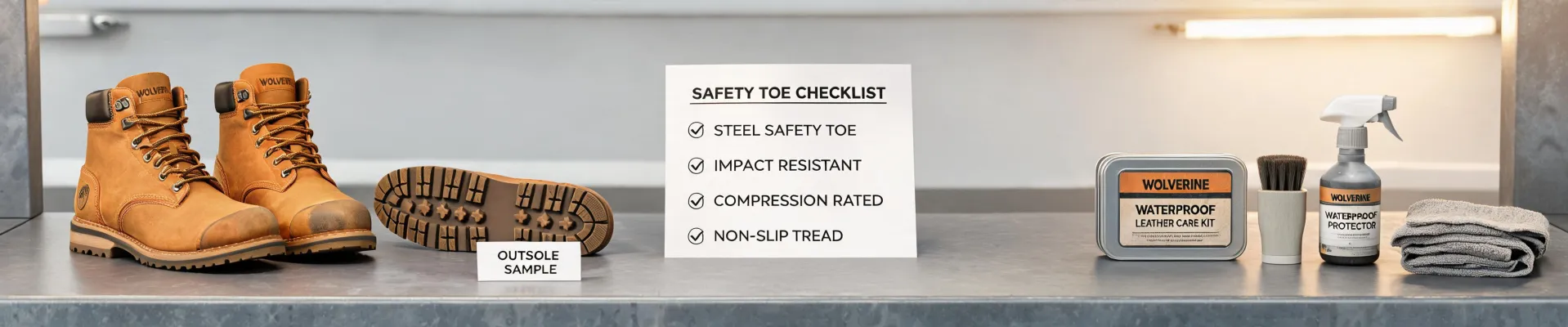
I’m a procurement manager for a 45-person construction materials company. I’ve handled our safety gear budget—about $120,000 a year—for over six years, negotiated with 30+ vendors, and tracked every order in a cost spreadsheet that’s been brutally honest with me. When someone asks, “What are the best work boots?” my honest answer is: it depends. The boot that makes sense for a warehouse worker might be terrible for a roofer. In this guide, I’ll walk you through the typical scenarios I’ve seen, and how to choose without wasting money or safety.
There’s No One-Size-Fits-All Answer
In my world, picking a work boot is less about finding the “best” product and more about matching the right tool to the environment. The first step is understanding which scenario you’re in.
Scenario A: Indoor and Light Industrial Work
If your crew is mostly inside—warehouses, assembly lines, loading docks—you need comfortable, certified protection. You don’t need an 18-inch logger boot. You need something that won’t kill your legs by hour eight.
Look for steel toe, alloy toe, or composite toe boots that meet ASTM F2413-18. Steel is the classic. Alloy is lighter, which means you can wear it all day without as much fatigue. Composite is good if you’re around metal detectors or need a non-conductive option. For indoor work, any of these will work, but I’ve seen “cheap” boots that have the rating stamped incorrectly or a toe cap that moves around. That’s a liability.
In this category, Wolverine’s basic work boots have been our go-to. They’re straightforward, they last, and they don’t cost an arm and a leg. I also get asked about Ariat a lot. To be fair, Ariat boots are comfortable out of the box—more so than most Wolverines. But when we put them on the same warehouse crew, the Ariat boots showed more wear after six months. Wolverine’s thicker leather handled scrapes and kneels better. If your work is more about walking than abuse, Ariat might be all you need. If you work around rough surfaces, Wolverine is the safer bet.
If you’ve been searching ‘wolverine work boots nearby’ to try them on, do that. Sizing is weird across models. I’ve seen a guy who wears a 10 in sneakers fit a 9.5 in one model and 10.5 in another. A quick trip to a local dealer can save you from a painful return loop.
Scenario B: Outdoor and Heavy Construction
Outdoor crews need real waterproofing and slip resistance. And I’m not talking about a spray-on coating—or rather, actual waterproofing means a membrane. In my first year, I made the classic rookie mistake of assuming every ‘waterproof’ boot was the same. One batch of budget boots failed after two weeks because the seam tape was cheap. That mistake cost $900 and a bunch of trust from the crew. Now I check the spec sheet for a membrane layer and search for independent reviews.
Wolverine’s waterproof lines have been solid for us. They aren’t the cheapest, but they hold up. If you do a lot of welding or work in cold weather, consider composite toe; it doesn’t transfer heat or cold as much as steel. Trust me, that makes a difference when you’re standing on a concrete slab in January.
Beyond boots, don’t neglect hard hats. I stopped buying the absolute cheapest ‘hard hat near me’ after seeing a cracked shell on a job site. Now I only buy hats that meet ANSI Z89.1, and I replace them on a schedule, not just when they look bad. A $30 hat is cheap compared to a hospital bill.
One thing many buyers overlook is the perimeter. If you need to fence off a hazard area, composite fence panels are a smart long-term investment. They cost more upfront than wood, but they resist rot, splintering, and pests. In my cost-tracking spreadsheet, composite panels beat pressure-treated pine over five years because you don’t replace them halfway through. If you’re managing a site, that’s a no-brainer for safety and budget.
Scenario C: Solo Workers or Tight Budgets
If you’re a one-person crew or running a small company, I feel you. The upfront price of good boots can be painful. But I always recommend running a TCO—total cost of ownership—calculation before you decide.
A $120 pair might last 8 months. A $180 pair might last 15 months. The cheap pair costs $15 per month; the premium costs $12 per month—and you get fewer surprises. If you only work part of the year, the math might flip. The point is to think beyond the sticker price.
Also, don’t ignore local stores. When I search ‘wolverine work boots nearby,’ I’m looking for fit and a relationship. The local store may offer bulk deals, handle warranty claims faster, or remember your size. I’ve had manufacturers refuse to replace defective boots when the online retailer “lost” the proof of purchase—that’s a headache you don’t need. If I remember correctly, that happened to us in 2023, and it was the last time I ordered that way without checking the small print.
The Small Things That Haunt You
Here’s a quick one: “Is a smoke detector supposed to blink red?” If it blinks once a minute or so, that’s usually the power indicator on AC-powered units. If it blinks more aggressively or chirps, it often means a low battery or internal fault. Don’t ignore it. I’ve seen a $15 battery cause a temporary office shutdown because the alarm kept chirping and nobody replaced it—then it went silent entirely. In a work environment, that’s not acceptable.
Another habit I’ve built: I review our PPE inventory twice a year. OSHA rules and ASTM standards update. If you buy once and forget, you could end up with non-compliant gear. I use a simple date field in my inventory list, and it has caught two outdated standards so far. It’s not glamorous, but it’s saved us from a couple of potential fines.
How to Tell Which Scenario You’re In
Still not sure? Ask yourself these three questions:
- Do I work mostly indoors or outdoors?
- How many hours a day do I actually wear the boots, and how rough is my environment?
- What is my true yearly cost if I factor in replacement frequency, not just the purchase price?
If you’re indoors, focus on certified protection and comfort—Wolverine’s basic lines are fine. If you’re outdoors, invest in real waterproofing, slip-resistant soles, and a proper hard hat. If you’re on a tight budget, do the TCO math before you order.
At the end of the day, the best gear is the one that still protects your people on day 100—not the one with the best tagline. And per FTC guidelines, be wary of claims like ‘100% injury prevention’—no boot can promise that. But an informed decision, based on your actual conditions, that’s the closest you’ll get to a guarantee.