Why I'm comparing Wolverine slip-ons and lace-ups
I'm the office administrator for a 180-person construction supply company, and I manage all PPE ordering—roughly $90,000 a year across 12 vendors. I report to both operations and finance, and after 5 years of managing these relationships, I've learned that safety-gear decisions are never just about safety. They're about wearer buy-in, inventory, and whether a boot that's technically correct actually gets worn.
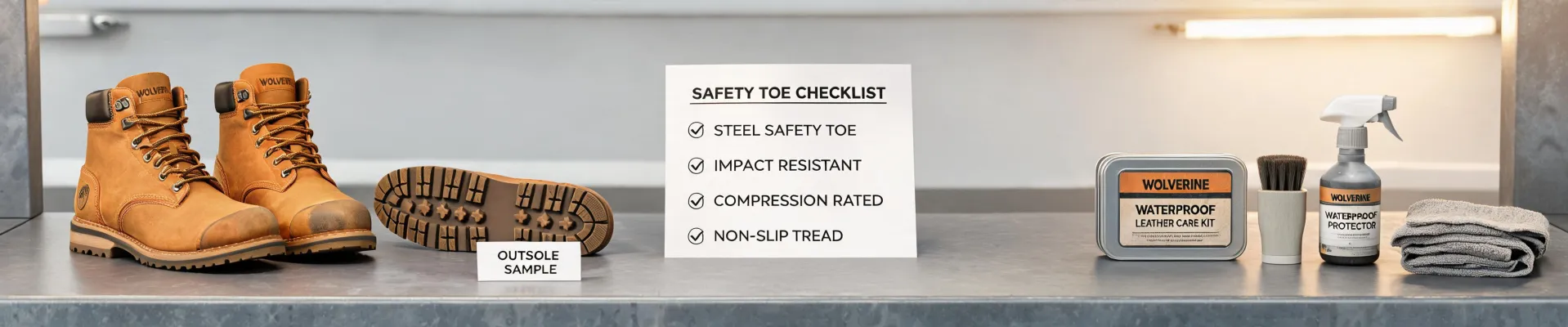
The two styles that come up most often on my order sheets are the Wolverine Men's Crawford EH Steel Toe Wellington Work Boots and lace-up styles like the Wolverine Avenger work boots. If you're looking at "Wolverine work boots slip on," you're probably deciding between exactly these two kinds of boots. So I'm comparing them the way I compare them for our crew.
- Daily usability and compliance
- Safety fit and real-world protection
- Purchasing logistics: SKUs, returns, and sample orders
Dimension 1: Daily usability and compliance
Slip-on Wellington boots are faster. That sounds obvious, but it matters more than you'd think. Some of our warehouse staff go through a safety zone six or eight times a shift. With laces, they either take extra time or skip the proper tie. A pull-on boot removes that whole argument.
I was a little skeptical at first. I figured a slip-on boot would feel loose or require constant adjusting. The Crawford EH has a solid heel pocket and enough structure that most workers didn't have that problem. I didn't time the change, but based on our supervisors' feedback, the difference was noticeable.
Verdict on dimension 1: slip-on wins for work environments where people suit up, step out, and repeat.
Dimension 2: Safety fit: the part a spec sheet doesn't show you
Both options can carry steel toe and EH ratings. But there's a difference between "this boot has a safety toe" and "this boot fits well enough to stay put when a worker is on a slope."
Lace-up boots give you more adjustability. You can tighten the midfoot, lock the heel down, and make the boot feel custom to your foot. That's a genuine safety advantage on uneven ground. Slip-ons are easier to get on, but you can't fine-tune the fit as much. Some workers have foot shapes that don't conform to a pull-on opening (think high instep or narrow heel). If the size is right, that's usually fine; if the size is wrong, a slip-on will never feel right.
Here's something vendors won't tell you: an online product name like "steel toe" does not tell you whether the boot meets the current ASTM standard. I check for ASTM F2413-18 markings before anything goes on our approved list. OSHA's foot protection rule (29 CFR 1910.136) requires protective footwear when there's a risk of injury, but it doesn't force an employer to look at how the footwear fits each worker. You have to do that part yourself.
If you need metatarsal protection, neither of these is the right category. That's a separate ASTM rating. I rely on standards first, not marketing.
Verdict on dimension 2: lace-up wins on adjustability, and slip-on wins on simplicity. For a mixed crew with normal foot shapes, I wouldn't call either one "safer." I'd call the correct size safer.
Dimension 3: Purchasing logistics, samples, and small orders
This is the part most reviews ignore. When I took over purchasing in 2020, I started keeping notes on return reasons. I don't have hard data on industry-wide rates, but based on our 60-80 orders a year, lace-up boots generated more sizing exchanges. That is not because they're worse—it's because people with high insteps or ankle concerns often order their usual shoe size, then the lacing feels too tight and they request a half size up.
Slip-on styles like the Crawford EH tend to run a little more predictable in sizing. That simplifies ordering, and it also simplifies replacement inventory. The downside is that if a crew member really does have a high instep, a slip-on can't be loosened like a lace-up. You need to catch that during the trial.
Here is where the "small order" part of my job comes in. We tested the Crawford with a six-pair order before committing. The distributor treated it like a normal order, not a charity case. That might sound basic, but after five years of vendor management, I've learned that the vendors who handle a small trial well are the ones who handle a large order well. Don't hold me to this, but a vendor's response to a two-pair sample order has predicted our long-term relationship better than any sales call.
Verdict on dimension 3: slip-on simplifies ordering, but a lace-up's adjustability can reduce fit problems for a multi-shift team if you're willing to stock more sizes. And any vendor who ignores a sample order is telling you what the future will be like.
Side questions that show up on the same PPE order
Boots are usually on the same PO as the rest of the PPE. Two questions come up all the time. "Are nitrile gloves safe for food handling?" Yes, if the box says food-safe or FDA-compliant for food contact. Not every nitrile glove is meant for food contact, so I read the label before buying for break room or light food-prep use. I do not have test data on every glove brand, so I rely on the label.
"What about insulated coveralls for men?" We issue them when people rotate into cold storage. I look for a shell fabric that can handle regular wear and an insulation rating matched to the temperature range. The principle is the same as the boots: find the item that fits the hazard, then make sure it's comfortable enough that people actually wear it.
What I'd order
If I'm being practical, I wouldn't standardize on one style. But if I had to build a default order list:
- Order the Wolverine Crawford EH slip-on for indoor, flat-floor environments and for crews that need to move quickly between clean and dirty zones.
- Order lace-up Avenger work boots for workers who spend time on uneven terrain, need strong ankle support, or want to dial in the fit.
- If you're not sure, buy samples first. A good distributor will support a two-pair trial. A distributor who won't should make you wonder.
No boot can guarantee 100% injury prevention, and be wary of any brand video that implies otherwise. The right move is to use the rating standard as your starting point, then test fit with real users. For us, the Crawford EH earned a spot in the catalog, and the Avenger style stays there for the parts of our work where adjustability matters more than speed. That's not a badge of indecision. It's a buying plan based on where the boots actually go.