-
Are Wolverine Boots Worth the Price?
-
Which Wolverine Work Boots Are the Most Comfortable?
-
Are Wolverine Military Boots Actually Good?
-
What About Chelsea Work Boots?
-
Wolverine or Durango Work Boots: Which Is the Smarter Order?
-
Steel Toe or Composite Toe for Wolverine Work Boots?
-
How to Clean Fire Extinguisher Powder Off Work Boots
-
What's the Hidden Cost Most Boot Buyers Miss?
Take it from someone who has signed a lot of boot purchase orders since 2020: if your job involves buying safety footwear, you need a different lens than the person wearing the boots. You need total cost, not just sticker price. This FAQ is based on the questions my employees and finance keep asking me about Wolverine boots.
Quick context: I'm not a footwear reviewer. I'm the office administrator for a 180-person industrial company. I manage all PPE and safety gear ordering, roughly $120,000 annually across eight vendors. I report to operations and finance. My job is to keep everyone safe, in compliance, and not blow the budget. If you're here for the fire extinguisher powder question, jump to that section. If you're comparing Durango work boots with Wolverine boots, that answer is down there too.
Are Wolverine Boots Worth the Price?
Here's the thing: 'expensive' and 'costly' are different. We spent between $150 and $240 a pair in 2024 for the Wolverine styles we purchase. As of January 2025, I'd expect the same range, but verify current rates. That sounds high next to an $85 option. But if that lower-priced pair lasts eight months and the $180 Wolverine holds up for 18 months, the cheaper boot is more expensive per month. You don't need a finance degree to see it.
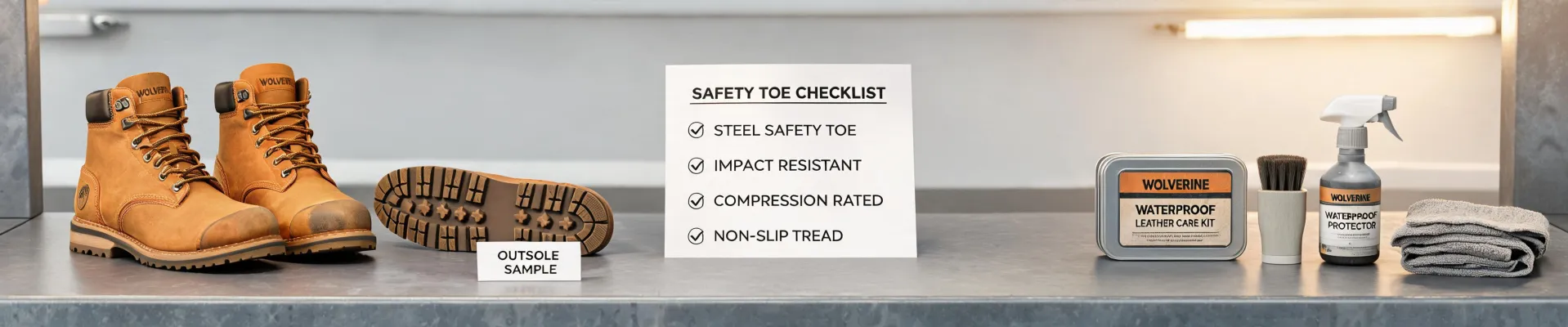
Wolverine boots have some features that matter beyond the invoice: ASTM F2413-18 safety toe protection, waterproof membranes, slip-resistant outsoles. According to OSHA (29 CFR 1910.136), employers must provide protective footwear when foot hazards exist. That's the compliance reason, not a marketing reason. Standards change, so verify current rules on osha.gov.
The most frustrating part of boot buying is that pricing conversations ignore downtime. You'd think safety is the point, but finance sees a cost line. So, bottom line: look at cost per day, not cost per pair.
Which Wolverine Work Boots Are the Most Comfortable?
I don't have hard data on comfort, because it's subjective. But after years of ordering, the Wolverine work boots people ask for by name are the Floorhand and the Overpass. The Floorhand is the classic steel toe work boot with a low-profile sole. The Overpass is a composite toe boot that weighs noticeably less. Both use the DuraShocks sole, and that seems to help on concrete floors.
I wish I had tracked comfort complaints more carefully from the start. What I can say anecdotally is that the response to the DuraShocks sole has been consistent. If you're looking for the most comfortable Wolverine work boots, ask about toe shape and last width, not just the foam. A wide-foot employee in a regular-width boot will complain no matter how much cushioning it has. Order a fitting sample before you buy 30 pairs. Trust me on this one.
Are Wolverine Military Boots Actually Good?
I need to be careful here: I've never served, so I can't speak to military procurement standards. But I've bought Wolverine tactical-style boots for security contractors, and for that use, they're solid. They're built on the same DuraShocks outsoles as the work boot line, with an aggressive tread and leather/nylon uppers.
Honestly, I'm not sure why Wolverine's tactical boots get less attention than their work boots. My best guess is that people only connect the brand with steel toe safety. Just remember: the name military doesn't mean every model is safety-rated. If your job requires a protective toe, check the ASTM F2413-18 label in the boot or on the spec sheet. If it's not there, it's a fashion boot, not PPE.
What About Chelsea Work Boots?
Chelsea work boots are the slip-on style with elastic side panels. For people who are in and out of trucks, machines, or clean rooms, they save a ton of time. No laces to break, no laces to trip on.
The catch is fit. With no laces, you can't adjust tightness. So a Chelsea boot has to match your foot more precisely. We order them for maintenance and supervisors, and they work best when you know your size in that specific last. Wolverine's Chelsea boots come with slip-resistant rubber outsoles, and some have safety toes. If you need a steel toe, read the spec sheet carefully. Not every Chelsea is ASTM rated.
Had 24 hours to decide before a rush order once, because a production line required no-lace boots. Normally I would have had a fitting session, but there was no time. Went with our usual supplier based on size charts. In hindsight, I should have ordered two sizes per person, because returns took longer than the rush window.
Wolverine or Durango Work Boots: Which Is the Smarter Order?
I've had employees show up in both. Durango work boots are popular with people who like western styling, soft leather, and a taller heel. They make some comfortable boots for that style. But when I'm ordering for a multi-site industrial company, I need consistency in compliance documentation and safety-toe options. That's where Wolverine boots won our account.
In our test group of 12 employees, the Wolverine pair held its shape better after six months of daily use. That's anecdotal, not a lab test. And to be fair, the Durango boots were comfortable in that western-style fit. If your crew is mostly on flat, dry surfaces, Durango may be worth a look. But for our mixed-site compliance needs, Wolverine made ordering easier. If you're choosing between them, make the decision on the toe hazard and the sole, not the logo. (note to self: ask warehouse about the Wolverine lace durability update in spring.)
Steel Toe or Composite Toe for Wolverine Work Boots?
I have mixed feelings about composite toe. On one hand, composite doesn't conduct electricity and weighs less in cold weather. On the other, steel toe is cheaper and has a longer track record. For most of our warehouse people, steel is fine. For supervisors who walk through metal detectors or work around electrical hazards, composite is worth the premium.
Don't treat one as better than the other. Treat them as job-specific. Wolverine makes both, and both can carry the ASTM F2413-18 rating. In 2023, we tested a composite-toe style with a five-person crew; all five preferred it. But the cost per pair kept us from switching everyone. Honestly, I've never fully understood the industry's shift to composite for everyone. My best guess is marketing plus the weight difference. Not every site needs it.
How to Clean Fire Extinguisher Powder Off Work Boots
Maybe you had a drill, or a real emergency, and now your boots look like someone dumped a bag of flour on them. Fire extinguisher powder, often ABC dry chemical, needs quick cleanup because it can draw moisture out of leather and leave a chalky film.
Here's the process I've used:
- Do it while the powder is dry. Brush or vacuum the loose stuff with a soft brush.
- Mix a small amount of mild dish soap with lukewarm water. Wipe the boot with a damp cloth. Don't soak it.
- For stubborn white residue, use a one-to-three vinegar-water solution on a cloth and wipe. That helps dissolve the residue.
- Air dry at room temperature. Keep them away from radiators and direct sun.
- Then apply a leather conditioner. Unconditioned leather will dry out and crack.
If your boots have a waterproof membrane, cleaning once shouldn't hurt. But don't machine-wash work boots. The agitation breaks down the safety toe protection and the sole bond. I don't have hard data on how many boots were ruined by washing machines, but I've seen two pair come out unwearable.
What's the Hidden Cost Most Boot Buyers Miss?
Downtime. If a boot fails on the job, someone has to leave the floor, get a ride, find a spare pair, and complete paperwork. The time cost often exceeds the boot allowance. When I calculate total cost, I include:
- purchase price
- expected lifespan from our maintenance team
- safety incidents linked to the model
- employee complaints, because they tell you which styles are actually getting worn
- ease of reorder: same style, same sizing, no last-minute returns
That's why we standardize on one or two Wolverine styles instead of chasing the lowest quote. It doesn't give us the cheapest invoice, but it gives us the lowest cost per day of protection. That's the last question, but it's usually the one worth asking first.