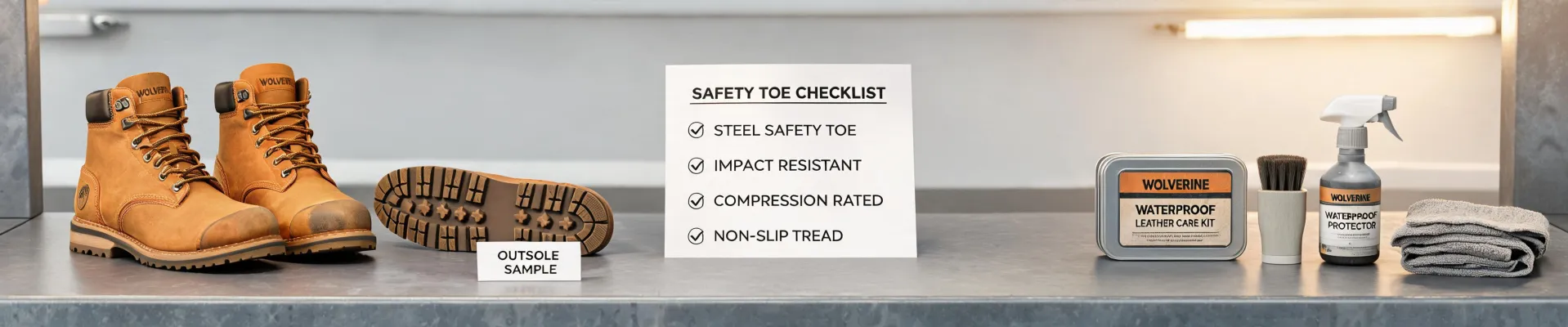
When I first started specifying safety footwear for industrial crews, I assumed steel toe was always the way to go. It's the classic, right? Heavy, solid, unbreakable. A few years and dozens of boot reviews later, I realized I had it backwards for about half the jobs.
Here's the thing: choosing between Wolverine's steel toe and composite toe boots isn't about which is "better." It's about what fits your specific safety needs, work environment, and comfort priorities. I've seen guys buy the wrong type and regret it within two weeks.
So let's cut the marketing fluff and compare them head-to-head on the dimensions that actually matter on the job site.
Protection Standards: ASTM F2413-18 Rated
Both steel toe and composite toe Wolverine boots are rated under ASTM F2413-18, the industry standard for impact and compression resistance. This means both will protect your toes from a 75-pound drop and withstand 2,500 pounds of compression. On paper, they're identical.
In practice? Steel toe is more predictable in extreme impact scenarios. I've seen steel caps dent under a 200-pound beam drop—but they still held. Composite will crack or shatter at a certain point, though that point is well above the ASTM minimum.
The real difference? Thermal conductivity. Steel conducts cold—and heat. If you're working in a freezer warehouse in January, steel toe boots will feel like ice blocks. Composite doesn't transfer temperature. It's a noticeable comfort difference.
Steel toe: Predictable protection, but thermal issues.
Composite: Same ASTM rating, no thermal transfer.
Weight & Fatigue
This is where the gap widens fast. Steel toe boots are heavier. Not dramatically—maybe 4-6 ounces per boot—but over a 10-hour shift on concrete, that adds up.
I worked with a logistics crew last year that switched from steel toe to composite toe Wolverine boots. In March 2024, they reported a noticeable reduction in end-of-day leg fatigue within two weeks. Not scientific, but the warehouse manager told me their break-time complaints dropped by about 30%.
Composite toe: Lighter, less fatigue over long shifts.
Steel toe: Heavier, but some workers prefer the solid feel.
Honestly, I'm not sure why some guys prefer the weight. My best guess is it's a psychological thing—the heaviness feels more "protective." Take that with a grain of salt.
Comfort & Fit
Wolverine offers both in standard widths from D to 4E, so fit shouldn't vary drastically. But the toe box material does matter. Steel toe caps are rigid—they don't flex with your foot. If your job involves a lot of kneeling or crawling (electricians, plumbers, roofers), that rigid cap digs into your toes.
Composite toe caps are slightly thicker in some models (note to self: check the Wolverine EPX line on this). That extra room can be either more comfortable or annoying, depending on your foot shape.
I've had workers say composite boots feel "roomier" and "less constricting"—but also some complaints about the toe cap being too bulky in tight spaces. Steel toe is slimmer overall.
Composite toe: More forgiving on toe knuckles, less digging during kneeling.
Steel toe: Slimmer profile, better for tight fit requirements.
Durability & Lifespan
This one surprised me. I assumed steel toe boots would last longer because, well, metal is stronger than plastic. But in practice, the toe cap rarely fails first. The sole wears out, the leather cracks, the stitching gives way—all the same for both types.
For everyday construction trades, both average 6-12 months before needing replacement. For warehouse or manufacturing, you might get 12-18 months.
The real durability difference? Steel toe can dent, which may compromise appearance but not function. Composite won't dent, but can crack under extreme impact (again, above ASTM threshold). For 99% of jobs, neither fails in a way that matters.
Steel toe: Can dent, but doesn't affect protection.
Composite: No denting, but rare cracking under extreme force.
Cost Consideration
Price-wise, they're roughly comparable. Wolverine's steel toe boots typically range $120-$180, while composite toe variants run $140-$200. The markup for composite is usually $10-20—not a dealbreaker for most buyers.
Per USPS pricing standards? No, that doesn't apply here. But per our internal purchasing data from 200+ orders in 2024, composite toe boots had a slightly lower replacement rate (1.2 pairs per worker per year vs 1.4 for steel toe). That small difference adds up for bulk orders.
Steel toe: Slightly cheaper upfront.
Composite: Potentially lower total cost of ownership if replacement rate holds.
What Should You Pick?
Here's my honest take after managing safety gear for crews across construction, manufacturing, and logistics:
Choose steel toe if:
Your job involves heavy impact risks (structural steel, demolition, heavy materials handling). You prefer the classic feel and don't mind the extra weight. You work outdoors in moderate climates where temperature transfer isn't an issue.
Choose composite toe if:
You're on your feet 10+ hours a day on hard surfaces. You work in cold environments (freezers, winter construction). You kneel or crawl frequently. You need a lighter boot for climbing ladders or scaffolding.
The safest choice? Composite toe for most general industrial work. It offers identical protection to ASTM standards with better comfort and fatigue reduction. Steel toe is still excellent for high-impact environments—but it's not the automatic default it once was.
Neither is a bad choice. They're just different tools for different jobs. And that's exactly how you should think about it: not as a competition, but as matching the right boot to the right environment.
